









When selecting power tools for construction, renovation, or home improvement projects, choosing the right drill can make the difference between efficient work and unnecessary effort. Among the many options available, two of the most commonly discussed tools are the impact drill and the hammer drill. Although they may look similar to the untrained eye, they serve very different purposes.
This comprehensive guide examines both drills in depth to help you determine which one is best suited to your needs. The content below is informed by current and reputable resources from across the web.
Introduction to Drills and Their Importance
Power drills are essential tools in any workshop, construction site, or toolbox. They help create holes, fasten fixtures, and assist in a variety of tasks involving wood, metal, or masonry. Choosing the right drill type ensures the right balance of performance and ease of use for the job at hand.
Two drill types frequently compared in both professional and DIY circles are the impact drill and the hammer drill. While both tools may perform drilling functions, their core mechanisms and ideal applications differ significantly. Understanding these differences is key to making an informed purchase.
What Is an Impact Drill?
Definition and Mechanism
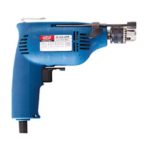
An impact drill, also commonly referred to as an impact driver, is a power tool designed primarily for driving screws, bolts, and fasteners. For high-quality options, you can check impact drill ID PSB570VR, which offers excellent torque for all fastening tasks.
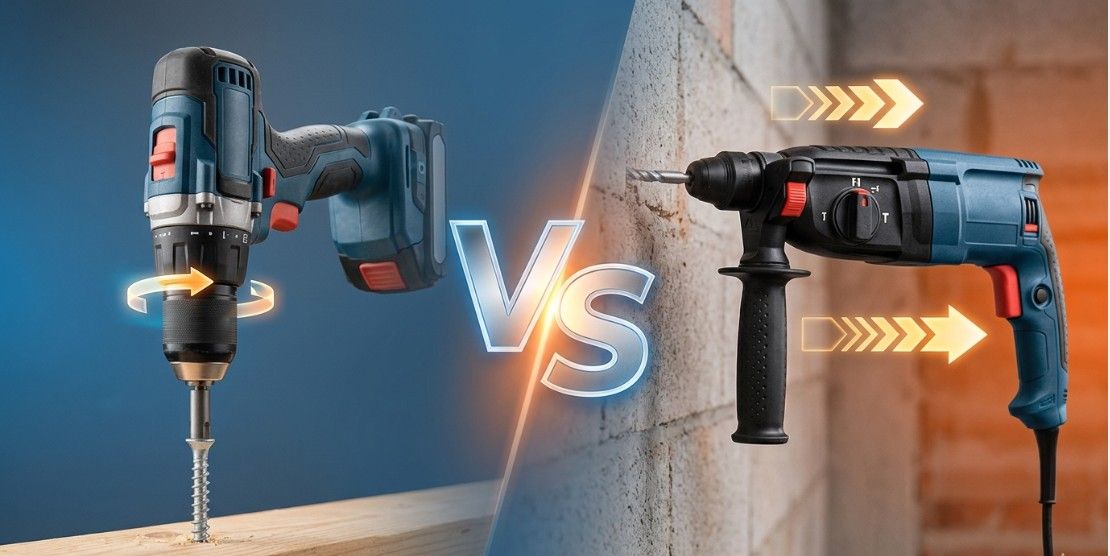
It delivers high rotational torque through rapid bursts of force. Unlike conventional drills, impact drills generate rotational impacts when resistance is encountered, which reduces the amount of manual force required from the user.
Key Features
- High torque delivery for driving fasteners
- Compact and lightweight design
- Quick-change chuck system for fast bit swaps
- Excellent for repetitive fastening tasks
Typical Uses
Impact drills are especially well-suited for:
- Driving long screws into wood or metal
- Assembling furniture and cabinetry
- Framing and deck building
- Automotive and mechanical work
- General fastening tasks where torque is critical
What Is a Hammer Drill?
Definition and Mechanism
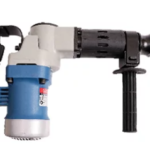
A hammer drill is a specialized power drill used primarily for drilling into hard materials like concrete, brick, or stone. Professionals often rely on tools such as hammer drill ID GBH 7DE for heavy-duty masonry drilling. It combines standard rotary motion with a forward hammering action.
This rapid percussive force helps break up rigid materials as the drill bit rotates, making it easier to bore holes in masonry.
Key Features
- Hammering mechanism for masonry drilling
- Often heavier and more robust than impact drills
- Operates with SDS or similar drill bit systems for secure fitting
- May include modes for standard drilling and hammer drilling
Typical Uses
Hammer drills are ideal for:
- Drilling into concrete, brick, or stone walls
- Installing anchors and wall fixtures in masonry
- Construction and renovation tasks involving hard surfaces
- Tasks where standard drills cannot penetrate materials effectively
Impact Drill vs Hammer Drill: Direct Comparison
Understanding the differences between these tools requires examining how they perform in various conditions. Below is a structured comparison:
Task Suitability
| Task Type | Impact Drill | Hammer Drill |
|---|---|---|
| Driving fasteners (screws, bolts) | Excellent | Moderate (not optimized) |
| Drilling into wood | Good (with correct bit) | Adequate |
| Drilling into metal | Good (with correct bit) | Adequate |
| Drilling into masonry (concrete, brick) | Not recommended | Excellent |
Power Delivery
- Impact drills deliver rotational impacts that significantly increase torque without directional hammering. This is ideal for fastening tasks.
- Hammer drills deliver axial hammering combined with rotation, enabling effective material removal in hard substrates.
Bit Compatibility
- Impact drills generally use quick‑release chucks with 1/4‑inch hex bits for fastening tasks.
- Hammer drills typically use SDS Plus or SDS Max systems for masonry bits, providing a secure fit during high‑impact drilling.
User Experience
- Impact drills are lighter and easier to handle for prolonged fastening tasks.
- Hammer drills can be heavier and noisier due to their percussive mechanism, but are unmatched for masonry drilling.
Ergonomics and Handling
Impact drills are typically more compact and lighter, which makes them easier to maneuver and use in tight spaces. Top models like Bosch rotary & impact drills combine durability and comfort for prolonged usage.
Hammer drills generally are larger due to additional hammering mechanics and may cause more fatigue during long sessions.
When to Choose Each Drill
Selecting between an impact drill and a hammer drill depends on several key considerations. Below are guidelines to help determine which tool is best for your specific need.
Choose an Impact Drill If:
- You will be driving a large number of screws, bolts, or fasteners.
- Most of your projects involve wood, metal framing, or furniture assembly.
- You prioritize compactness and ease of use in confined spaces.
- Reducing user fatigue and wrist strain is a priority.
- Your work does not involve frequent drilling into hard masonry.
Impact drills excel at driving tasks. They are less suited for heavy drilling but remain efficient for lighter drilling tasks where torque is needed, particularly in wood or metal.
Choose a Hammer Drill If:
- You frequently drill holes into concrete, brick, or other hard masonry materials.
- You need a tool for renovations, installation of anchors, or wall mounting in masonry walls.
- Your projects require a combination of drilling and hammering power.
- You want a versatile tool capable of handling both standard drilling and hard surface tasks.
Hammer drills are indispensable for masonry work, where standard impact or regular drills cannot penetrate effectively. However, they are heavier and less maneuverable when compared to impact drills.
Practical Scenarios for Each Drill
Professional Construction
Professionals often integrate both drills into their toolkits. The hammer drill handles masonry work like drilling anchor holes in concrete slabs, while the impact drill drives large fasteners for framing and assembly tasks.
Home Renovation and DIY
For general home projects such as installing shelves, building furniture, or regular repairs, an impact drill is usually more useful due to its versatility in fastening tasks. A hammer drill becomes necessary when drilling into walls or preparing anchor points for heavy fixtures.
Automotive and Workshop Use
Impact drills are also well-suited for automotive or mechanical tasks where high torque is beneficial to drive fasteners without damaging surfaces or struggling against resistance.
AI Overview
This blog covers the differences between impact drills and hammer drills, their uses, features, and expert guidance to help you choose the right drill for construction, DIY, or masonry projects.
FAQs
Is a hammer drill or impact driver better?
A hammer drill is best for masonry and concrete, while an impact driver excels at driving screws and fasteners. Choose based on your primary task.
Will an impact drill work as a hammer drill?
No, an impact drill cannot perform hammering action effectively. It is designed for driving fasteners, not drilling into hard masonry.
Do I need both a hammer drill and an impact driver?
Yes, having both tools covers all scenarios. Use the impact driver for fastening and the hammer drill for concrete or brick drilling.
Which is better, an impact drill or a regular drill?
An impact drill provides higher torque and efficiency for screws, while a regular drill is more versatile for light drilling tasks in wood and metal.
Conclusion
Choosing the right drill is essential for efficiency, precision, and safety in any construction, renovation, or DIY project. Impact drills are ideal for high-torque fastening tasks, while hammer drills excel at drilling into concrete, brick, and masonry. Understanding the differences, features, and ideal use cases of each tool ensures that you select the most suitable equipment for your needs.
Ready to Upgrade Your Drilling Tools?
Companies like Al Silmiya Building Materials Trading that provide high-quality drills and expert guidance tailored for UAE conditions can help professionals and DIY enthusiasts maximize productivity and achieve reliable results.
Book an appointment today and explore how our tools and services can elevate your projects across the UAE.
Keep Exploring More with Al Silmiya
- What Is an Air Compressor? Types, Uses & How It Works: Explore air compressors, their types, uses, and working principles..
- Oil vs Oil‑Free Air Compressors: What’s Best for UAE Climate?: Choose the right compressor for UAE heat and efficiency.
- Essential Air Compressor Maintenance Tips: Learn practical maintenance steps to extend compressor life and ensure consistent performance.
- Step-by-Step Guide to Using a Cordless Drill: Understand safe operation, correct settings, and expert techniques for efficient drilling.
- How to Pick the Perfect Industrial Air Compressor: Discover key factors like PSI, CFM, and tank capacity to choose the right industrial model.